


💼 Flash Forward 2026: Midlife Health at Work
Updated: Apr 17
Singapore will become a super-aged society within the next five years (i.e. 20% to 21% or more of the population aged 65 or older).
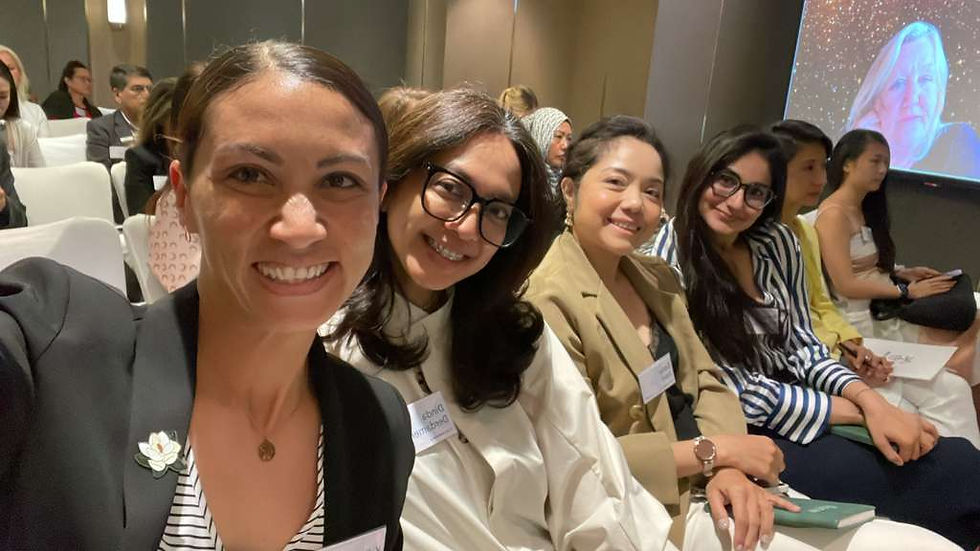
Attending the FLASH FORWARD 2026: Menopause, Longevity & Workplace Health Summit, hosted by Sol (Spring of Life) Founder Grace Oh & Team, made it clear that we have only just begun designing for the reality of aging women's lives, especially the impact in the workplace.

Held in Singapore and convening academic researchers, policymakers, clinicians, ecosystem-builders, employers, consumers and FemTech Association Asia, the summit discussed midlife health as a workforce, economic and societal priority.
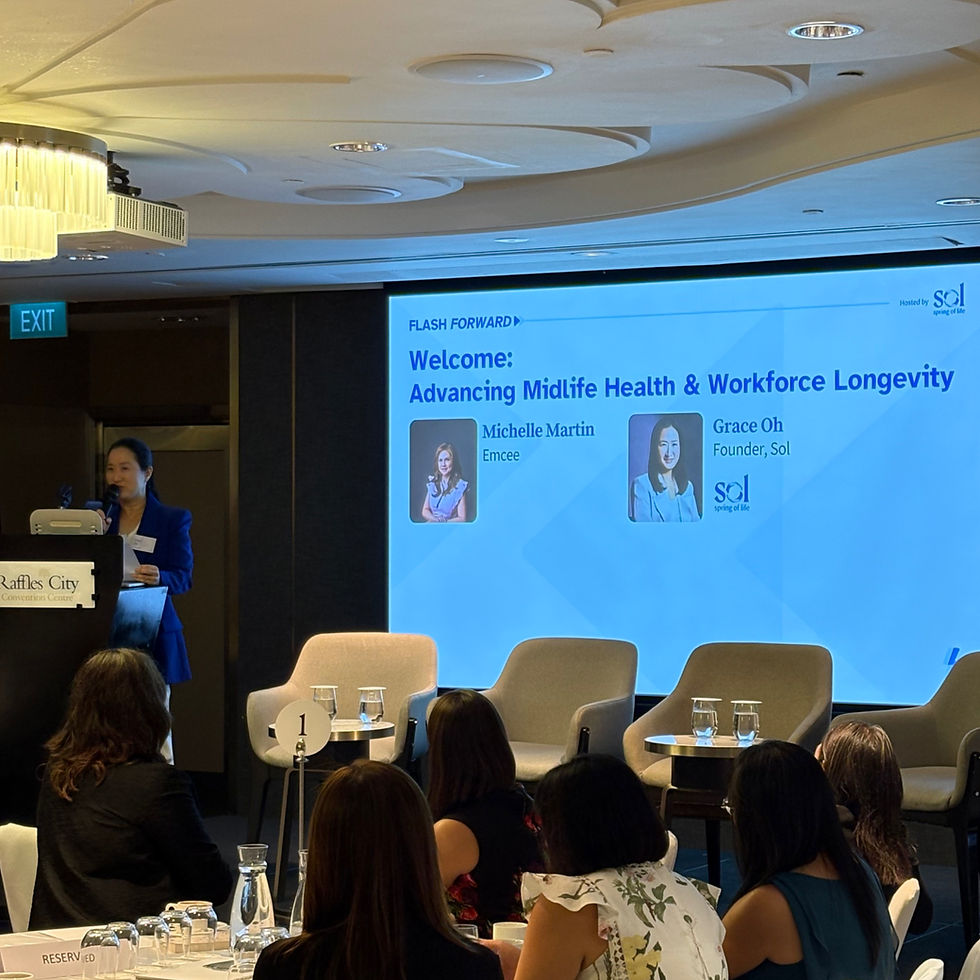
This Is a Workforce Issue, Not Just a Health One
In the opening address, Yeo Wan Ling framed midlife women’s health as a policy and economic priority, building on decades of advocacy by the National Trade Union Congress Women & Family Unit.
Singapore has long supported women through policies like fair pay and flexible work but the next frontier is midlife health. As women stay in the workforce longer, health transitions are shaping productivity, retention and leadership pipelines.
The Scale of the Problem
One of the most striking insights presented in the keynote by Professor Huang Zhongwei was just how widespread and under-recognised the issue is.
From the ACRLE x HeyVenus research presented, there are stark disparities between the prevalance of menopause symptoms and the support available to working women across APAC:
70% of women experience multiple menopause symptoms
2 in 3 report disruption to work and daily life
61% cite stigma as a barrier
45% feel uninformed
Even more telling:
71% of organisations believe menopause support would benefit them, yet only 31% have policies in place.
Close to 50% of women, many at the peak of their careers, have not sought professional healthcare advice for their symptoms, instead relying on the internet or family members for information.
This is not a knowledge gap. It is an execution gap.

Asian Women Experience Menopause Differently
Asian women report a broader and more severe range of symptoms compared to Western counterparts.
Beyond hot flashes and night sweats, women reported:
Fatigue (the most prevalent)
Cognitive challenges (forgetfulness, difficulty focusing)
Anxiety and mood changes
Sleep disturbances and weight gain
Note: Professor Szoecke cited an average of 8kg gained per woman during peri/menopause.
Nearly half of women said these symptoms significantly disrupted their work performance.
This reframes menopause from a “wellness” issue to a leadership and productivity issue.
The Workplace Hasn’t Caught Up Yet
During the panel “When Menopause Shows Up at Work” featuring Uma Thana Balasingam, Juanita Mega and Diana Tan, moderated by Dr Seow Yian San, the conversation moved from awareness to action.
The evolution of Flexible Work Arrangements (FWAs) stood out with flexibility no longer about remote work, but how the workplace and workplace policies are redesigned.
Emerging solutions include:
Job redesign and part-time pathways
Temperature-controlled environments and rest spaces
Satellite workspaces and co-location models (e.g. near childcare)
Manager training on menopause awareness
Forward-thinking employers like Unilever and HSBC are already experimenting with midlife support, but consistency across companies, industries and countries is lacking. There is no global standard of best practice...yet.

Menopause Is an Economic Issue at Scale
The economic argument is impossible to ignore.
Globally, menopause is estimated to drive $120 billion in lost productivity, with $60 billion attributed to Singapore alone. Menopause is not just a health issue; it is a hidden driver of economic loss, absenteeism, and talent attrition.
And yet, the majority of women are still navigating it alone.

What Good Looks Like
Professor Huang outlined what a system-level response for women's midlife care could look like:
1. Workplace Regulation
Recognise menopause as a legitimate occupational health issue
Introduce workplace accommodations
Protect health disclosures
2. Healthcare Provision
Subsidise menopause care (including MHT - menopause hormone therapy)
Train physicians on menopause management
Note: KKH, in collaboration with the College of Family Physicians Singapore and the College of Obstetricians and Gynaecologists, Singapore, launched Singapore’s first guidelines on the management of the menopause transition in February 2026. These guidelines aim to standardize menopause support across all specialties.
Expand specialised clinics
Examples: In Singapore - Osler Health, Prologue, HeyTaylor; Philippines - Kindred.
3. Public Health Education
Multilingual awareness campaigns
Workplace-integrated education
Community and digital support platforms
Singapore has the opportunity to lead globally regionally, not just in women's healthspan and longevity, but in how we support it.

Why Midlife Health Shapes Long-Term Outcomes
In the session on brain health, Professor Cassandra Szoeke highlighted the link between hormones, cognition and aging.
Two points stood out:
Women account for two-thirds of dementia cases.
Preventative actions (including physical activity and early intervention) are critical.
At the same time, decades of misunderstanding, particularly around hormone therapy, has slowed adoption, access, research and funding.
In Singapore: 87% of women still do not discuss menopause symptoms.
There is a clinical AND cultural gap.

The Real Barrier: Silence
Women are not speaking up, not because they don’t want to, but because systems are not designed for them to.
Stigma, lack of education, and workplace cultures all contribute to this silence.
And until that changes, policies alone will not be enough.
According to FemTech Association Asia & Milieu Insight research, across Southeast Asia, 52% of women feel it’s culturally unacceptable to discuss women's health issues in public, particularly due to fear of judgement or shame.
This is where the femtech industry brings added-value with consumer trust, safe spaces and localised solutions, like Sol (Spring of Life).
Designing for the Future
Singapore is preparing for longevity, though we cannot build a future-ready workforce without designing for women in midlife.
This means:
Embedding women’s health into economic policy
Moving from awareness to implementation
Designing workplaces that reflect biological realities
The question is no longer if menopause will impact the workforce; it already
is. The question is whether - and how quickly - we choose to design for it.


Hi
The discussion regarding workplace health and longevity at the Flash Forward 2026 summit is incredibly insightful, particularly as it highlights the necessity of supporting individuals through various life stages and their associated pressures. As a PhD student currently navigating the intense rigors of doctoral research while working part-time at last minute assignments, I see a clear parallel between corporate health initiatives and the academic support systems we need. My work assisting others with their technical hurdles stems from my own history of having suffered through many high-stress hustles and sleepless nights during my college days, which made me deeply conscious of how an unmanageable workload can impact one’s long-term well-being. This personal background is why I have such a genuine…
hi